
High RTP slots, therefore, are simply the slots that have higher-than-average RTP. In order to understand what “higher than average” really means and how to find these slots based on their RTP on any casino website, is to alter how you play more than nearly everything else you can learn about slots.
I’ve tested countless of these games over the years — mostly due to curiosity about why some sessions seemed to be generous, and other sessions seemed to slowly suck the life out of me. And RTP was the quiet factor behind a lot of this. It’s not flashy; it doesn’t appear in the bonus round animation; however, it does far more to help shape your gaming experience than the theme, the sound effects or the size of the jackpot banner.
What does RTP stand for in slots?
RTP stands for return to player. As a percentage, it shows how much money wagered on a slot gets returned to players over a long period of time (i.e., a very large number of spins). Essentially, a 96% RTP slot theoretically pays back £96 for every £100 wagered on the game with the remaining £4 representing the house edge. However, the RTP is not derived from the results of a few hundred spins or even a few thousand spins. Providers test various combinations of game settings and run simulations of tens or hundreds of millions of spins in order to arrive at an RTP that is statistically reliable and verifiable through auditing and publication by third-party testing laboratories prior to licensing the game to a casino.
While there are certainly caveats to consider, particularly the fact that RTP represents long-term averages and not your Tuesday night gaming session, the difference in RTP between two games with similar stakes, payouts and Volatility can be significant. In particular, high RTP slots tend to favor players who engage in regular gaming sessions rather than occasional visits to the casino during special events.
High RTP slots: what is considered high RTP?
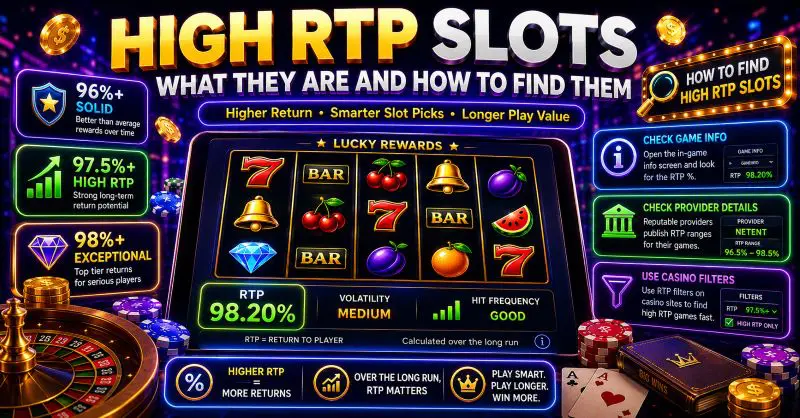
As mentioned earlier, industry-wide average RTP for online slots falls within the 95-96% range. Therefore, any slot offering an RTP above 96% would be considered “better than average.” Additionally, many reviewers and players begin referring to slots as having a “high RTP” after crossing the 97.5% threshold. Finally, as soon as a slot crosses 98% or better into the realm of truly exceptional.
To provide perspective, Mega Joker from NetEnt boasts an impressive 99% RTP and Jackpot 6000 from NetEnt comes in at approximately 98.9%. Ugga Bugga from Playtech reportedly has an RTP of approximately 99.07% and Relax Gaming’s Book of 99 delivers precisely what its name suggests – a 99% RTP. Barcrest’s Ooh Aah Dracula and NetEnt’s Blood Suckers each report an RTP of approximately 98% while Thunderkick’s 1429 uncharted seas reports an approximate RTP of 98.6%.
More recently, OneTouch launched Rise of the Mighty Gods with an approximate RTP of 99.1% and Spinmatic released games such as Fairy Dust Xtreme and Poseidon Xtreme featuring 99% RTP. Again please note that RTP values may vary among markets and/or casino configurations since some operators license adjustable RTP versions of the same game. Always verify the actual RTP value displayed on the platform you are actively gaming on versus any value(s) you read elsewhere.
It is important to acknowledge that RTP is merely one component of determining whether or not a slot is enjoyable. A high RTP slot with extremely poor Volatility and an extremely lengthy wait between bonus rounds may prove to be more frustrating to play than a well-designed game with an acceptable 96% RTP.
RTP vs. Volatility
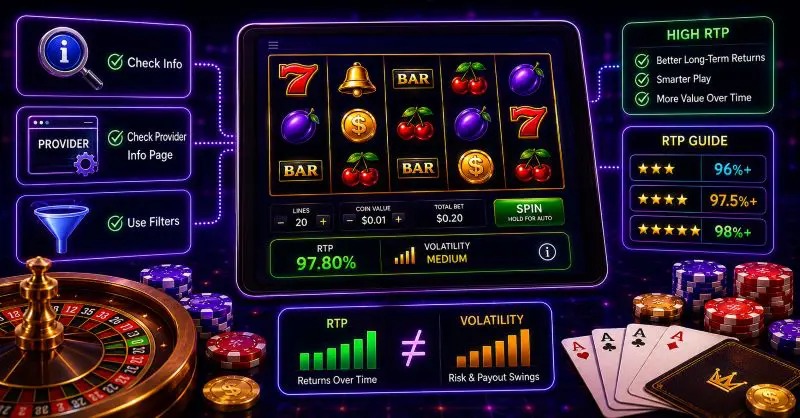
At this juncture, many players confuse these two distinct variables. Volatility refers to how the money is distributed throughout a session whereas RTP refers to how much money is eventually paid back to the player via all wagers placed on a slot. Low Volatility slots payout frequently but with moderate payouts, which tends to keep your Bankroll somewhat intact and allows for extended playtime utilizing the same budget. High Volatility slots payout less frequently but often result in multipliers several orders of magnitude greater than your initial stake amount.
Thus, it is possible for a slot to feature both high RTP and high Volatility simultaneously. An example includes Tombstone RIP from NoLimit City boasting an RTP of approximately 96% and exhibiting extreme Volatility with a maximum win multiplier reported to be upwards of 300,000 times your original stake. Conversely, Blood Suckers has a substantially lower Volatility (and thus a shorter wait between wins), yet offers a stronger 98% RTP compared to Blood Suckers.
Hit Rate/Frequency:
There exists an additional factor related to both RTP and Volatility referred to as hit rate or frequency. Simply stated, this measures how often a spin produces a winning combination regardless of its size. A slot can produce many hits while maintaining low Volatility if most wins are small in nature. Similarly, a slot can exhibit infrequent hits while producing large wins when they occur. Neither RTP nor Volatility, nor hit rate provides the complete picture regarding a slot. Together they do provide insight into how to select a suitable game for your preferred type of gameplay.
Locating high RTP slots on any casino website
Fortunately, finding the RTP value for any specific slot typically is not obscured by default, although it is rarely presented prominently either. Therefore, locating said information requires a bit of effort. Typically, modern slot games feature an info icon or i-button located adjacent to the spinning controls in a corner of the screen.
Tapping upon this icon reveals the paytable along with the respective RTP value, Volatility rating & max win multiplier. In addition, certain casinos display the RTP value immediately adjacent to/within their game thumbnails & filter options within their lobbies, which is arguably one of the most useful ux decisions made by operators in regards to facilitating users ability to sort/filter games by RTP before loading them.
Practical habits for locating high RTP slots
Verify that you are reviewing the correct RTP value specific to how that casino has configured that particular game. Such values can differ between markets & casino versions of said game.
Review your operator’s terms & conditions page as some operators list an overall range of RTP values for each title or even provide a full listing.
Visit the provider’s official website directly as many studios publish their own results alongside Volatility & maximum winnings for every single title they release.
Utilize comparison tools offered by websites such as Casino which allow users to sort games specifically by their respective RTP percentage rather than popularity & newest release dates.
A note regarding adjustable RTP versions
A small number of providers create multiple versions of the same game with different RTP values & make available only the version they choose to license to each individual operator. This creates situations where a fan forum or older review may display an incorrect/rarely used RTP value for a specific title compared to the actual value listed within the information panel of the exact game on the platform being utilized at the time of usage. Therefore, when possible trust the numbers provided within the game’s own information screen first.
Which type of slots will help you match your gameplay style?
If you are newer to online slots, starting off with high-RTP/low-medium-Volatility slots would be a good place to begin with. Not only do these slots have higher payout frequencies which provides players with longer sessions per dollar/pound wagered but also provides players with a steady Bankroll so they can spend more time learning how bonus rounds & pay lines function prior to running out of funds. Blood Suckers & Jackpot 6000-type games fit well into this category as both feature strong 98+ % RTP without extreme Volatility and long wait times between bonuses.
More experienced players who have larger bankrolls built up to handle larger swings can enjoy playing high-RTP/high-Volatility slots because although the math still favors the player long term due to their favorable RTP %, session upside potential exists as wins will come infrequently but will potentially carry large upsides. Tombstone RIP from nolimitcity exemplifies this concept extremely poor in short-term periods, yet has a maximum win ceiling that far surpasses those of lower Volatility games.
In general Bankroll management plays a much greater role than the actual RTP value as a high-RTP game played at a bet size too large for your budget will drain your Bankroll just as quickly regardless of the variance against you during any given session.
Common Question Responses
What does RTP mean in slots?
Returns to player as a percentage showing how much money placed on a slot gets returned to players through all wagers made on a slot after a very long run (tens of millions) of spins calculated by the slot provider & audited/vetted by third-party testing laboratories before licensing the slot to a licensed casino.
What is considered a high-RTP slot?
Slots offering an RTP above approximately 97.5% are generally viewed as high-RTP slots with any slot providing an RTP of 98% plus being exceptional.
Do high-RTP slots guarantee more wins?
Absolutely not! Long-term average returns on investment are measured by RTP but your next three wins or losses are determined by randomness & luck alone!
Are high-RTP slots better suited for beginners?
Generally yes — especially when paired with low/medium Volatility as this combination allows for more frequent smaller wins & more stable balance levels for beginner players spending less time studying how bonus features & paylines work before losing funds.